
Located in the peaceful Alpheios River valley in the Peloponnese, Ancient Olympia stands as one of the most significant archaeological sites in the world. It wasn’t a city in the traditional sense, but rather a sacred precinct—the Altis—dedicated to Zeus, the father of the Greek gods.
The Birthplace of the Olympic Games
For over a millennium, from 776 BCE to 393 CE, Olympia was the center of the Panhellenic world every four years. During the Sacred Truce, all conflicts between warring Greek city-states ceased, allowing athletes and spectators to travel safely to honor Zeus through physical excellence.
Key Monuments and Landmarks
The Temple of Zeus
Once the largest temple in the Peloponnese, this Doric masterpiece housed one of the Seven Wonders of the Ancient World: the colossal chryselephantine (gold and ivory) statue of Zeus seated on a throne, sculpted by the legendary Phidias. Today, its massive fallen columns give a haunting sense of its original scale.
The Stadium
Unlike modern arenas with tiered seating, the Olympic stadium was a simple, rectangular field surrounded by grassy embankments where up to 45,000 spectators sat. Entering through the stone Krypte (a vaulted tunnel), you can still see the original stone starting lines (balbis) where runners once stood.
The Heraion (Temple of Hera)
One of the oldest monumental temples in Greece, this structure was dedicated to Zeus’s wife, Hera. In modern times, it has regained global fame as the site where the Olympic Flame is lit before every Olympic Torch Relay using a parabolic mirror.
The Philippeion
A unique circular memorial (tholos) commissioned by Philip II of Macedon after the Battle of Chaeronea. It served as a powerful political statement, showcasing the Macedonian royal family’s prominence within the Greek world.
The Palaestra and Gymnasium
These were the training grounds for athletes. The Palaestra, with its beautiful colonnaded courtyard, was specifically used for wrestling, boxing, and jumping, while the Gymnasium provided space for long-distance runners and javelin throwers to practice.
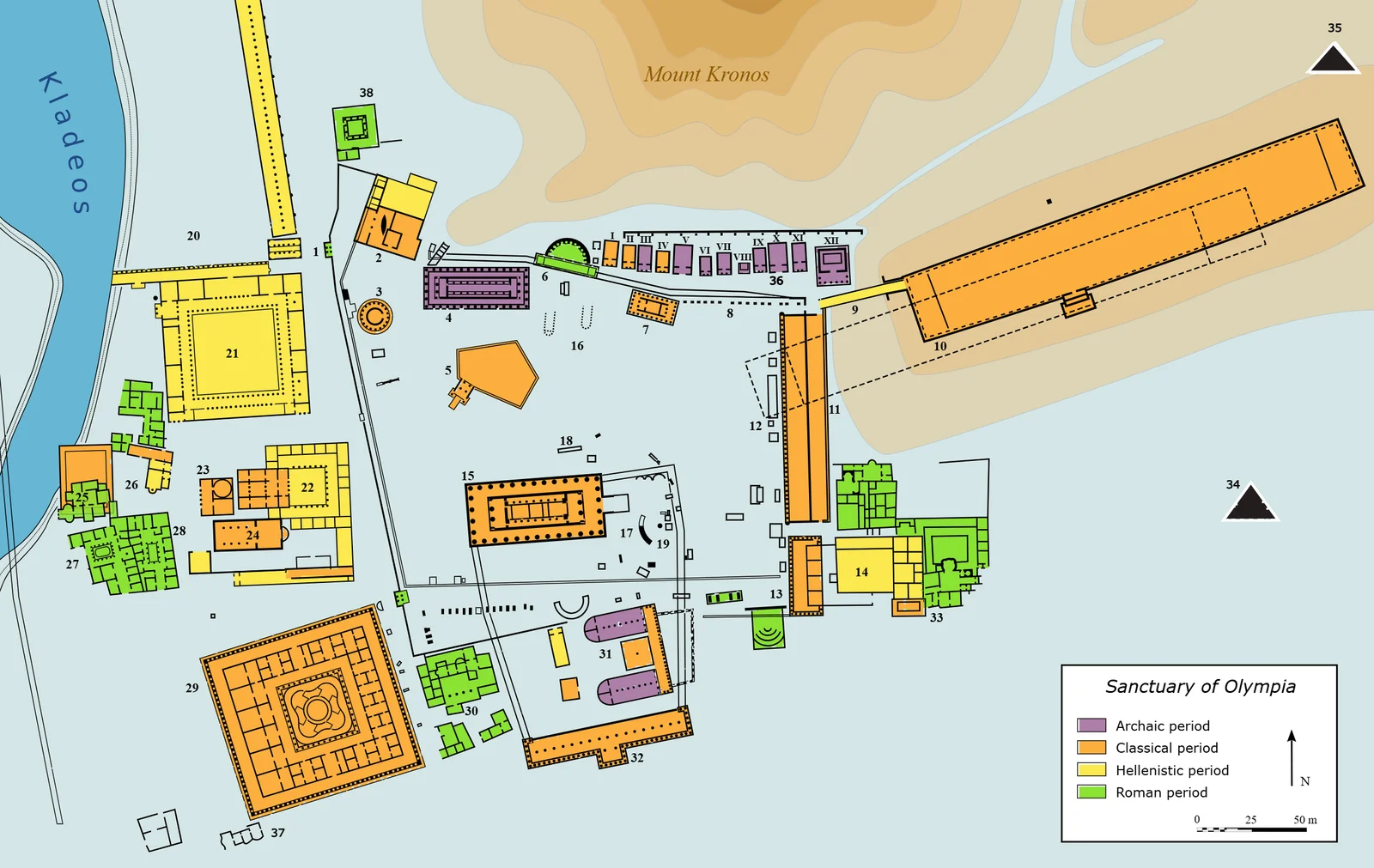
Key to numbers
Temples and sacred venues
The core religious structures including temples, altars, hero-shrines, and victory dedications.
Temples
4: Temple of Hera
7: Metroon (dedicated to Rhea, the mother of the gods)
15: Temple of Zeus
Altars & Shrines:
5: Sanctuary of Pelops (Pelopion)
16: Altar of Zeus
23: Heroon (shrine to the “unknown hero”)
Dedications
3: Philippeion (Monument of Philip II)
8: Zanes¹ (read footnote about cheaters in the games)
12: Monument of Ptolemy II and Arsinoe²
17: Dedication of the Achaeans
18: Dedication of Mikythos of Rhegion
19: Nike of Paionios (statue of Victory at the Battle of Sphakteria)
36: Terrace of Treasuries
Athletic venues
The specialized spaces where athletes trained and the official competitions took place.
10: Stadium (For track and field events).
9: Crypte (The vaulted entrance for athletes).
20: Gymnasium (Large open space for track and field training).
21: Palaestra (The colonnaded courtyard for combat sports).
34: Hippodrome (The track for horse and chariot races; lost).
Administration
2: Prytaneion (The seat of the magistrates and the location of the sacred hearth)
31: Vouleuterion (The Council House where athletes took their official oaths)
35: Shrine of Demeter Chamyne³
Infrastructure / Water / Baths
Essential facilities for hygiene, water management, and the physical transitions within the site.
1: Northeast Propylon (The ceremonial gateway to the sanctuary)
6: Nymphaeum of Herodes Atticus (The grand ornamental fountain and aqueduct terminus)
14: Hellenistic Building (General infrastructure structure)
25: Baths of Kladeos (Named after the nearby river)
26: Greek Baths (The oldest bathing facilities on site)
30: Southern Baths (Late Roman-style bathing complex)
37: Leonidaion Baths (named after Leonidas of Naxos, an architect)
- 38: Kronios Baths (at the foot of Kronios hill)
Stoas (covered porticos)
These long, colonnaded halls provided shelter from the sun and rain, as well as space for commerce and social gathering.
11: Echo Stoa (Also known as the Poikile Stoa, famous for echoing a voice seven times)
13: Stoa of Hestia (goddess of the hearth and domestic life)
32: South Stoa (The southern boundary of the sanctuary used for official arrivals)
Lodgings/Workshop/ Staff
The residential areas for athletes, distinguished guests, and even emperors.
22: Theokoleon (official residence for the Theokoloi, the high priests of the Sanctuary of Zeus)
24: Workshop of Phidias and Early Christian Basilica
27 and 28: Lodgings (Standard accommodation units)
29: Leonidaion (The largest building on site, serving as a luxury hotel for VIPs)
33: Villa of Nero (The private residence built for the Emperor’s visit in 67 AD)
¹ Technically, the Zanes weren’t a single shrine, but a row of 16 bronze statues of Zeus located at the entrance to the Olympic Stadium. While most statues in Olympia were built to honor winners or gods, these were built to immortalize cheaters.
² The story of Ptolemy II Philadelphus and Arsinoe II is one of the most fascinating—and scandalous—chapters of Hellenistic history. It involves a “power couple” who redefined the concept of divine royalty, merging Greek political savvy with Egyptian religious tradition.
³Priestess of Demeter Chamyne was the only woman of marriageable age allowed to officially attend the Olympic Games. She sat upon this marble altar to watch the events, a position of immense honor that signaled the goddess’s oversight of the competition.