Delos Island
Mythology
According to legend, Delos wasn’t always a fixed island. It was originally a floating piece of land called Ortygia (the “Quail Island”).
- The Birth of Twins: When the daughter of Titans Coeus & Phobe, Leto became pregnant by Zeus, a jealous Hera forbade any “solid ground” or continent to receive her for the birth. Delos, being a floating island, didn’t count as “solid ground” and offered Leto refuge.
- The Divine Event: Leto clung to a palm tree (still symbolized on the island today) She wandered around looking for a place to give birth. Then Zeus asked Poseidon, god of the sea, to give shelter to Leto. And he immobilized the invisible islet right in the center of the Aegean Sea. Leto gave birth to the twins Artemis (goddess of the moon) and Apollo (god of the sun).
- Anchoring the Earth: To show his gratitude, Zeus (or Poseidon) anchored the island to the sea floor with four diamond pillars, transforming it into the most sacred site in Greece. Because the “God of Light” (Apollo) was born here, the island was named Delos, which means “visible” or “manifest.”
History
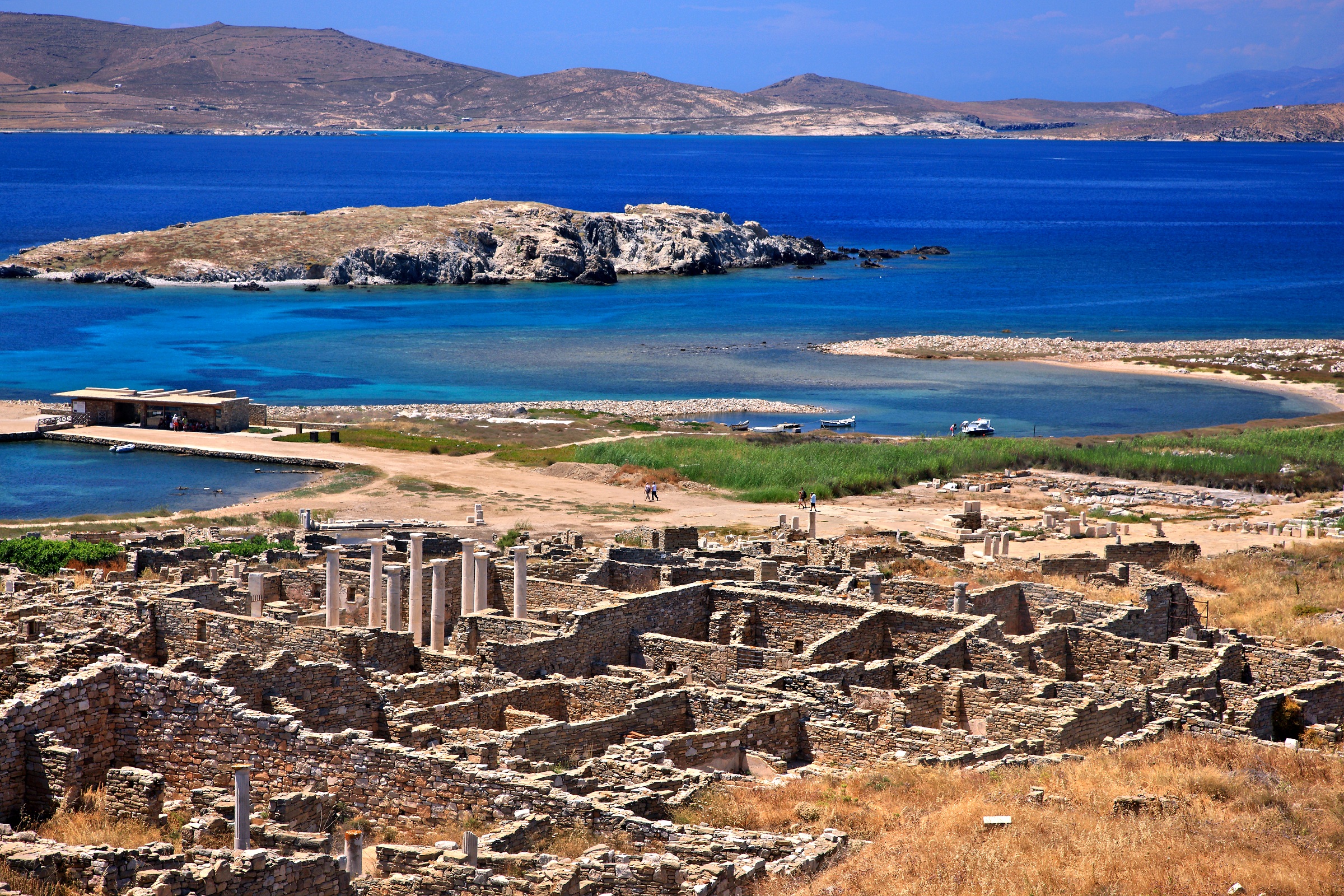
Excavations reveal that Delos was inhabited from the 3rd century BC. millennium (traces of circular huts were found on the summit of Mount Kynthos). In the Mycenaean Era, and especially in the period 1580-1200 BC, there was a settlement on Delos in the plain, near the port. Later, as in the rest of the Cyclades, the Ionians settled. During the Geometric Era, the island developed considerably. From 700 BC, we have references in Homer to the all-holy Ionian Sanctuary of Apollo. Over the years, it gained prestige and respect, and the Ionian cities dedicated rich offerings to it.
Delos transitioned from a religious sanctuary into a massive cosmopolitan hub, but it always maintained its “holy” status. The Delian Games were celebrated every four years with games, theater, symposia, music and more. In the ancient world, they were the most famous games, after the Olympics and the Pythian Games.
Purification Laws
Because the island was the birthplace of gods, it had to remain “pure.” In the 5th century BC, the Athenians enacted strict laws:
No one could be born or die on Delos. Pregnant women and the terminally ill were ferried to the neighboring island of Rineia to keep the sacred soil untainted by the messiness of human mortality.
The Delian League
After the Persian Wars (478 BC), Delos became the headquarters for the Delian League, an alliance of Greek city-states led by Athens. The league’s massive treasury was kept here until Pericles infamously moved it to the Athenian Acropolis in 454 BC (using the funds to build the Parthenon).
Age of Commerse
In 167 BC, the Romans declared Delos a free port. This turned the tiny island into the commercial capital of the world. At its peak, roughly 30,000 people lived on this 3-square-kilometer rock. It was a melting pot where Greeks, Romans, Phoenicians, and Egyptians lived side-by-side, leaving behind a incredible array of temples to various gods (like the Temple of Isis).
The Decline
The island’s prosperity made it a target. It was sacked twice, first by Mithridates VI of Pontus in 88 BC and later by pirates in 69 BC. It never recovered. By the 7th century AD, it was abandoned, leaving its ruins preserved by the sun and salt until excavations began in 1873.
Archaeological Highlights
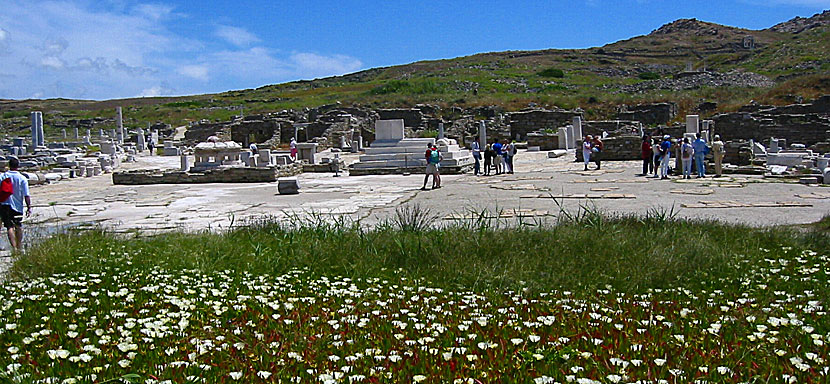
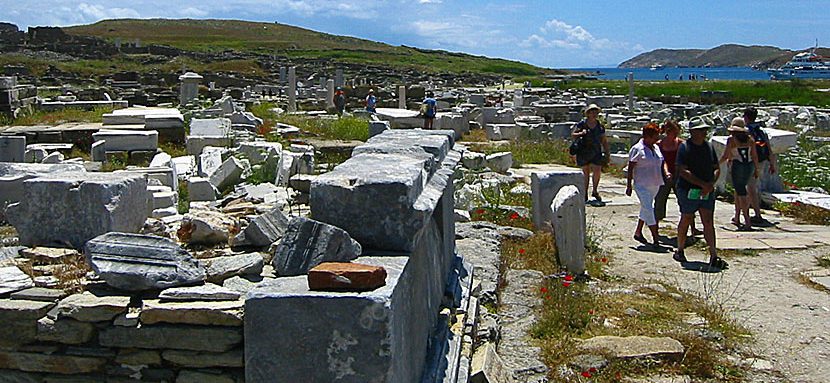
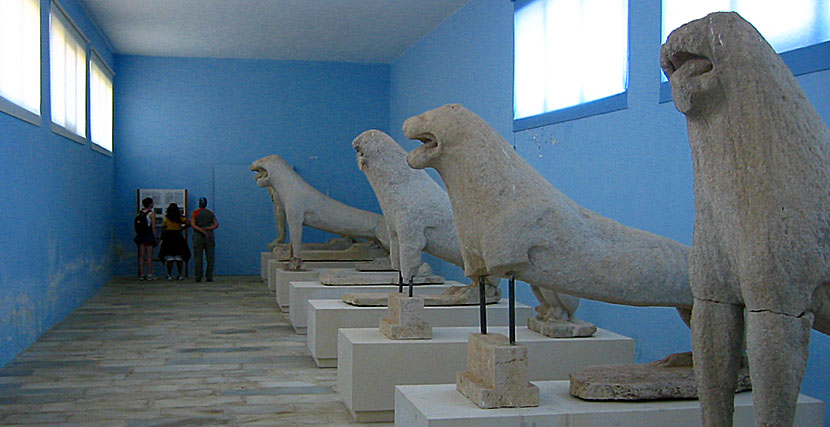
Today, Delos is a UNESCO World Heritage site and essentially an open-air museum.- The Terrace of the Lions: Originally 9 to 12 marble lions (now 5 remain) dedicated by the people of Naxos to guard the Sacred Lake.
- The House of Dionysus: Famous for its stunning floor mosaics, including one depicting the god Dionysus riding a panther.
- Mount Kynthos: The island’s highest point, offering a view of the “Cyclades”—the circle of islands that literally “cycle” around the sacred center of Delos.