
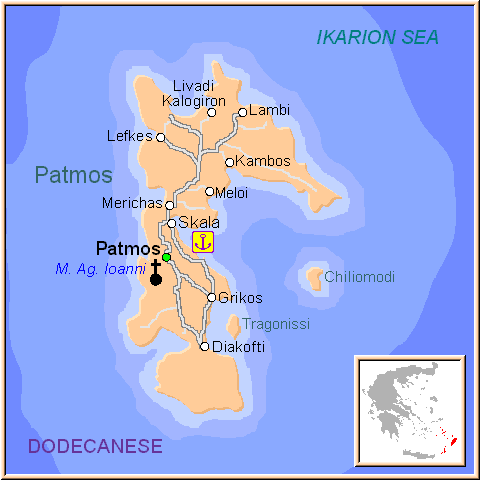
Patmos, is located in the northern part of the Dodecanese island group in the southeastern Aegean Sea,close to the Aegean coast of Turkey.
It has a distinctive shape, some call it a sickle or a sea horse. The island is narrow with many bays, composed of three main landmasses connected by two thin isthmuses. At its narrowest point near the port of Skala, the land is only about 300 meters wide.
The terrain is primarily hilly and rocky, reaching its highest point at Profitis Ilias, which stands at 269 meters above sea level. It boasts an extensive coastline relative to its size, featuring numerous deep-water bays, secluded coves, and sandy or pebbled beaches.
Patmos is relatively arid and sparsely vegetated, dominated by low-lying Mediterranean scrub (maquis and phrygana), though there are small pockets of pine trees and agricultural terraces where vines and olives are grown.
Patmos Outline
- Atmosphere: Patmos strikes a balance between profound spirituality and sophisticated, quiet luxury. It lacks the loud nightlife of Mykonos but offers a “mystical” energy that attracts artists, writers, and pilgrims.
- Geography: It is a small, “hook-shaped” island with a deeply indented coastline (63 km) that creates numerous natural harbors and secluded coves.
- UNESCO Status: The entire historic center of Chora, the Monastery of St. John, and the Cave of the Apocalypse are protected World Heritage sites.
- Vibe: Outside of the religious landmarks, the island feels rural and authentic, with terraced hills, wild herbs, and a slow-paced lifestyle. Patmos attracts a “quiet luxury” crowd—think sophisticated travelers and artists rather than the neon-and-bass-drop tourists. The landscape reflects this; it is elegant, unpretentious, and deeply serene.
Landscape
The terrain is primarily rocky and arid, characterized by low-lying hills covered in phrygana (aromatic Mediterranean scrub) and the occasional splash of green from olive groves or pine clusters. Because the island is relatively small and narrow, you are rarely out of sight of the sea.
The light here is famously intense. It bounces off the white-washed walls of the Chora and reflects off the dark, volcanic stone, giving the island a high-contrast, cinematic feel. Unlike its greener neighbors, Patmos relies on its rock formations and deep blue bays to provide its visual drama.
Patmos (Chora) Village
Medieval Chora Landmarks
A UNESCO World Heritage Site, Chora is widely considered one of the most beautiful villages in Greece. It is a labyrinth of whitewashed houses, narrow alleys, and hidden squares built around the central monastery. Exploring here feels like stepping back in time, with historic mansions belonging to sea captains still standing as they did centuries ago.
- Holy Monastery of Saint John the Theologian: A towering 11th-century fortress-monastery that dominates the island’s skyline. It houses a priceless collection of Byzantine icons, ancient manuscripts, and religious relics in its museum. This 11th-century fortress-monastery dominates the island’s skyline. Its dark, massive stone walls were built to protect the monks and their treasures from pirate raids. Inside, you’ll find a stunning courtyard, Byzantine-era frescoes, and a museum housing a priceless collection of icons, gold-embroidered vestments, and rare manuscripts.
- The Windmills of Patmos: Three beautifully restored 16th-century windmills located on a hill overlooking the sea. They offer some of the best panoramic views of the island, especially at sunset.
- Nikolaidis Mansion: A grand 17th-century residence that has been converted into a museum. It provides a rare look into the lives of the wealthy Patmian families during the island’s golden age of trade.
- Simantiri Mansion: One of the oldest homes in Chora (dating to 1625), still functioning as a private museum filled with antique furniture, traditional embroidery, and historical artifacts.
- Agia Lesvia (or Levia) Square: The social heart of the upper town. It’s a picturesque spot to enjoy a coffee at “Thanassis,” a legendary local kafeneio, or a quiet meal under the stars.
- The Nunnery of Zoodochos Pigi: A serene 17th-century convent known for its flower-filled courtyards and intricate wood-carved iconostasis.
- House of Emmanuel Xanthos: The birthplace of one of the founders of the Filiki Eteria (the secret organization that sparked the Greek Revolution).
- Cave of the Apocalypse: Located on the hillside just below Chora, this is the sacred grotto where Saint John is said to have received the visions for the Book of Revelation. Located halfway between the port of Skala and the hilltop Chora, this is the sacred site where St. John lived during his exile. You can enter the small chapel built into the rock and see the triple-fissure in the ceiling—where tradition says the voice of God spoke to John—as well as the indentation in the rock where the saint supposedly rested his head.
- Profitis Ilias: The highest point on the island, reachable via a hike south of Chora. It features a small chapel and 360-degree views of the surrounding Dodecanese islands.
The Old Donkey Path: A historic cobbled trail (built in 1794) that connects Chora to the port of Skala. It’s a scenic 20-minute walk through pine trees and wildflowers.
Rest of Patmos
Skala (The Main Port)
The bustling heart of the island where the ferries dock.
It serves as the commercial hub, filled with white-washed houses, Italian-style administrative buildings, and a vibrant waterfront lined with cafes and tavernas.
- The Three Windmills: Standing on a ridge overlooking the harbor, these restored 16th-century mills offer the definitive panoramic view of the island’s narrow “waist” and the sprawling Aegean beyond.
- Kastelli Archaeological Site, where the ruins of an ancient Hellenistic acropolis offer one of the best sunset views over the Aegean. Skala is the island’s bustling heart. While Chora is for views and history, Skala is where you’ll find the best tavernas, shops, and cafes. It is a lively hub that balances modern amenities with traditional island architecture, serving as the main base for visitors.
- The Cave of the Apocalypse
Located halfway along the steep road between Skala and Chora. This sacred site is where St. John the Theologian is said to have heard the voice of God and dictated the Book of Revelation. The interior remains rugged, featuring the “triple fissure” in the rock through which the Divine voice supposedly spoke.
Kampos (Vibrant & Green)
Divided into Pano (Upper) Kampos, a traditional inland village, and Kato (Lower) Kampos, a popular seaside area.
Kato Kampos features the island’s most organized beach, known for its shallow, crystal-clear waters and tamarisks providing natural shade.
It is one of the few fertile regions on the island, dotted with orchards, olive groves, and pine trees.
Grikos (Quiet Seaside Retreat)
A former fishing village in the southeast that has evolved into a calm, upscale resort area.
It sits in a protected bay that looks more like a lake than the open sea.
The highlight here is Petra (Kalikatsou Rock), a massive volcanic monolith on the beach that was once used as a hermitage by monks.
Remote & North-End Beaches
- Psili Ammos: Only accessible by a 20–30 minute hike or a boat from Skala, it is widely considered the most beautiful sandy beach on the island, featuring high dunes and a wilder feel.
- Lambis: Famous for its unique, multi-colored volcanic pebbles (which are strictly forbidden to take).
- Livadi Geranou: A serene, unorganized beach on the northeastern tip, offering views of the nearby uninhabited islets and a small chapel (Agios Georgios) at its edge.
- Petra Beach: A striking pebbled beach with crystal-clear water, located right next to the Kalikatsou rock. Overlooking Petra Beach, this massive volcanic formation was once an ancient sanctuary and later a hermitage for monks. You can still see the carved steps and water cisterns. It’s a popular spot for photography, especially at sunset when the light hits the orange-hued rock.
- Kampos: The most “organized” beach with water sports and popular beachside tavernas.
Nearby Islets (Arkoi & Marathi)
Small, “Lilliputian” islands accessible by day-trip boats from Skala.
They offer ultimate seclusion, turquoise waters (especially the Tiganakia “blue lagoon” area), and a handful of remote tavernas for fresh fish.
Local Flavors
Don’t leave without trying the Patmian Tyropita, a local cheese pie that is more like a dense, open-faced tart filled with local cheeses. Another favorite is Poungi, a traditional sweet made of honey and nuts wrapped in a pastry pouch.